Sierra Peaks List
Generated on 10 Aug 2024 - see revision history - please send updates to the webmaster
 View All GPS Waypoints: download GPX file.
 |
Richard Carey has lots of data on these and other peaks, and his SPS and DPS sections are good places to start browsing. These pages are distinct from the SPS website.
The Vulgarian Ramblers maintain a list of all CA 13ers, based on the best available USGS field survey and DEM data. For more details on DEM data, see the "Some Notes on Data Accuracy", "Column Descriptions and Color Usage", and "Even More Technical Information" sections of their web page.
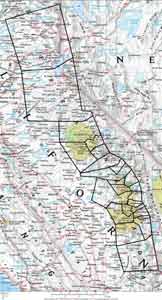
This list was prepared as a convenient reference to many of the major peaks of the Sierra Nevada, by combining the official SPS Peaks List Sierra Peaks Section, Angeles Chapter, Sierra Club) and the Major Sierra Peaks list (as published in the "Scree" newsletter of the Peak Climbing Section, Loma Prieta Chapter, Sierra Club) plus a bunch that I added because I've been there or someone asked me to add them. It is hoped that this list will aid people both in choosing a peak to climb and in planning the trip. This version includes peaks not on the SPS list, which are labeled with 'XX' so they can be found and deleted to recover the official SPS Peaks List, as with "The Sphinx 11.xx".
IN GENERAL, "EMBLEM" peaks dominate the area by their bulk or the amount of terrain that can be seen from the summit, and "MOUNTAINEERS" peaks represent high quality alpine climbing. Obviously, there are worthy climbs not on this list - and there are also peaks on this list that have trails to the top! The peaks are grouped into 24 geographical areas that are listed in a south to north direction. The names of the 15 emblem peaks are capitalized and marked with 'E' and the 35 mountaineers peaks are marked with 'M' between the region number and the peak name in the regional listings.
The climbing class (difficulty rating) indicates the difficulty of the easiest route on the peak, but this is not necessarily the most commonly climbed route. The classes are summarized here, but a detailed description of ratings is online:
The cartographer of the new 7.5 min maps seems to have shifted the summit location of Mt Powell and Mt Emerson but the SPS (and the USGS's GNIS database) continues to recognize the nearby older and higher location. The 7.5 min Mount Whitney map has the spelling "Mt Chamberlain" but the correct name is "Chamberlin", which is used on the older 15 min map, since the mountain was named by the Sierra Club for geologist Thomas Chrowder Chamberlin.
Useful Links:
